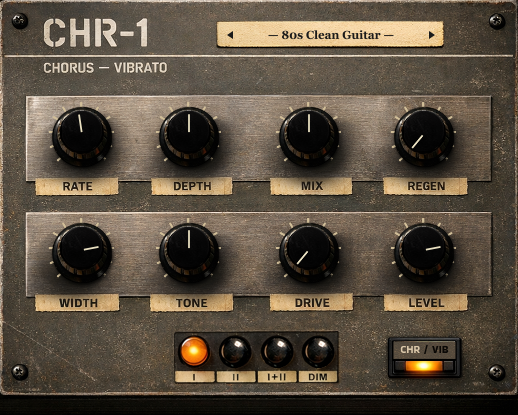
A BBD chorus is a chorus effect built on a bucket brigade device, an analog delay chip that passes the audio signal through thousands of tiny capacitor "buckets." Each handoff loses a little high end and adds a little character, which is why BBD chorus sounds warm, dark, and slightly imperfect where digital chorus sounds clean and static. The Boss CE-2, Roland Dimension D, and the chorus baked into the Juno synths are all BBD designs, and that circuit behavior, not the wobble itself, is most of what people mean when they say a chorus sounds "vintage."
The first time I noticed it was on a Cocteau Twins record. Robin Guthrie's guitar wasn't really a guitar in the normal sense. It was this watery, blooming, slightly out of tune halo of sound, and every digital chorus plugin I owned at the time made my own guitar sound nothing like it. I'd push the depth knob, push the rate, swap algorithms, and end up with something that felt synthetic. Plastic. Like a guitar wearing a costume.
The thing I was missing was the circuit. Specifically, the bucket brigade circuit, the analog delay chip that powered every great chorus, vibrato, and flanger pedal from roughly 1976 through the late 1980s. Once I understood what BBD was actually doing to the signal, both the sound I wanted and why my plugins were missing it started to make sense.
This is a long article, but if you've ever wondered why the Boss CE-2 sounds the way it does, why Mk.gee's modulation hits differently than yours, or how to choose between chorus, vibrato, flanger, doubler, and phaser, that's what this is for.
What a BBD Actually Is
BBD stands for bucket brigade device. It's an analog integrated circuit that delays an audio signal by passing it through a long line of charge-storing stages, like a fire brigade passing buckets of water hand to hand. Each stage holds the signal for one tick of an external clock, then dumps it to the next stage. The clock speed determines the delay time. Faster clock means shorter delay. Slower clock means longer delay.
The two chips that mattered most were both made by Panasonic. The MN3007 (1024 stages) and the MN3207 (also 1024 stages but lower voltage) showed up inside almost every chorus and flanger pedal of the late 70s and 80s. There was also Reticon's SAD1024, which Electro-Harmonix used in the original Electric Mistress flanger. These chips weren't really designed for music. They were intended for delay lines in things like radar systems and reverb units in TVs. Musicians just got curious.
What makes BBDs sound the way they do is what happens to the signal as it travels through those 1024 stages. Each stage loses a tiny bit of charge during the transfer, which translates to a small loss of signal amplitude and, more importantly, a progressive loss of high frequencies. By the time your guitar's pick attack has traveled the full delay line, the top end has been quietly shaved off. Longer delays sound darker than shorter ones. This is one reason a Boss CE-2 set to slow chorus has that liquid, slightly underwater character. It's not an EQ curve. It's the chip itself getting tired by the end.
BBDs are also noisy. Inherently. The signal gets tiny doses of clock noise, switching artifacts, and thermal hiss as it passes through. Every classic BBD pedal solved this with a compander circuit, usually the Signetics NE570 or NE571. The compander squeezes the signal hard before it enters the BBD, then expands it back out at the end. That keeps the noise floor down. It also creates the subtle pumping you hear on percussive material running through a CE-2. Hit the strings hard and the signal compresses for a beat before opening back up. Producers either love it or hate it.
Why Digital Chorus Often Sounds Wrong
Most chorus plugins model the math. They take your signal, apply a short delay (typically 5 to 30 milliseconds), modulate that delay time with a low frequency oscillator, mix it back with the dry signal, and call it a day. That's a chorus. Technically. But it misses the things that make the analog version feel alive.
Three big ones, in my experience:
The high-end darkening. A real BBD signal sounds noticeably darker than the input. Not from a low-pass filter sitting on top, but from the cumulative charge transfer loss inside the chip. Get this wrong and your chorus sits on top of the mix instead of nestling into it.
The bucket coloration. BBDs introduce small phase shifts at very specific frequencies because of how the stages couple to each other. There's typically a midrange resonance somewhere between 600 Hz and 1.2 kHz, depending on the chip and the surrounding circuit. Without that bump, the chorus feels too pristine.
The compander pumping. Even at low depth, the compander on a real CE-2 is doing something to your transients. Plugins that ignore this usually feel rigid. The signal moves but doesn't breathe.
The other thing that's easy to miss is what happens to noise. BBD pedals were never quiet. There's always a faint analog hiss, and that hiss is part of the texture. Plugins that strip it out can sound clinically clean, which is the opposite of what you want.
Five Modes, One Family
The interesting thing about BBD chips is that the same circuit can produce wildly different sounds depending on how you set the delay time, the modulation, and the feedback. Five named effects all come from the same family. Four of them genuinely use BBDs. The fifth, phaser, doesn't, but I'll explain why it ends up in the same conversation.
Chorus
The default BBD effect. Delay time around 4 to 12 milliseconds, modulated slowly (typically 0.3 to 1.5 Hz), low feedback. The wet signal blends with the dry signal, and because the wet signal is constantly being detuned by the modulating delay, you get a sense of two slightly different copies of your guitar playing in unison.
Chorus came of age in 1976 with the Boss CE-1 Chorus Ensemble, which was the first standalone chorus pedal in the world. It pulled the chorus circuit out of the Roland JC-120 amp and put it in a tank-sized stomp box. The CE-1 had two modes, chorus and vibrato, and a switch to choose between them. The vibrato mode killed the dry signal, leaving just the modulated wet, which is why CE-1s show up on so many records doing pitch-warble work, not just stereo widening.
By 1979 Boss had simplified the CE-1 into the CE-2, which is the pedal you hear all over 80s clean guitar records. It runs an MN3007 and an MN3101 clock chip, with a compander for noise reduction. There are exactly two knobs. Rate and depth. That's it. The CE-2 became the chorus that defined a decade.
Modern uses for chorus are all about subtlety. Push the mix up to 30 or 40 percent, set rate slow, depth low, and you get that liquid 80s clean tone that runs through indie guitar, dream pop, bedroom pop, and a wave of CCM worship records. Mike Gordon, who records as Mk.gee, builds his guitar tones around this kind of slow, restrained chorus. So does Wallows. So does anyone trying to hit the late-period Sunday-morning indie sound.
Vibrato
Vibrato is chorus with the dry signal removed. Just the modulated wet. Because there's nothing for the wet signal to interfere with, you don't get the characteristic "two voices" sound of chorus. Instead you get pure pitch modulation. The note bends up and down at whatever rate you set the LFO.
The classic vibrato sound has nothing to do with BBDs originally. It came from Magnatone amps in the late 1950s, which used a true pitch-shifting circuit driven by varistors. By the time BBD chips were widely available, the cheaper way to get vibrato was to just kill the dry signal on a chorus pedal. The Boss CE-1's vibrato switch did exactly this. So did the BF-2 flanger when it was set to short delay with feedback turned off.
In a modern context, BBD vibrato is what gives you the warm, slightly drunk pitch wobble you hear on Beach House and a lot of Daniel Lopatin's work. Used at low depth and slow rate, it's basically tape warble. Push it harder and it becomes that blurry psychedelic effect on a held chord.
Flanger
Flanger is chorus with much shorter delay times and aggressive feedback. Where chorus operates in the 4 to 12 millisecond range, flanger lives between 0.5 and 5 milliseconds, which is short enough that the wet and dry signals create comb filtering. As the delay time sweeps, the comb filter sweeps with it, producing that metallic jet-engine whoosh.
Feedback is what separates a subtle chorus from a screaming flanger. Take the same BBD circuit, drop the delay range, crank the regeneration loop, and the same chip becomes the EHX Electric Mistress, the MXR M117 Flanger, the Boss BF-2. The Police's "Walking on the Moon" is essentially a slow flanger on a clean guitar. Andy Summers used it to fill empty space, which is the trick. Flanger in 2026 is mostly used the way Summers used it. Slow sweeps under sparse parts, building tension without taking up frequency real estate.
Doubler
The doubler is the strangest of the five, because it predates BBD chips entirely. It started at Abbey Road in 1966, when an engineer named Ken Townsend invented Artificial Double Tracking (ADT) so John Lennon could stop having to record his vocal twice. The original ADT used a tape machine with a varispeed motor to delay the signal by a few tens of milliseconds, then mixed it back with the original. The result sounded like Lennon had naturally double tracked himself, but with a slight shimmer.
BBD chips made ADT cheap. By the early 80s, every studio had a BBD-based doubler in a rack somewhere. The trick is asymmetric timing: the left channel gets one delay (around 15 milliseconds), the right channel gets a slightly different delay (around 25 milliseconds), and a very slow LFO drifts both delays so the doubling doesn't feel mechanical. The dry signal gets removed entirely on each side, then summed back in stereo. You hear the original voice in the center and two phantom doubles slightly out to the sides.
Doublers work on basically any monophonic source. Lead vocals, lead guitars, electric piano lines, single-note synth leads. The reason you hear it on so much 80s rock is that pop production in that era was obsessed with making single performances sound like ensembles. Doublers were the cheap way to do it.
Phaser
Phaser is the odd one out. Phasers don't use BBDs at all. The classic MXR Phase 90 from 1974 uses a chain of FET-based all-pass filters whose resonant frequencies are swept by an LFO. There's no delay involved. The signal just gets its phase response chewed up at moving frequencies, which mixes with the dry signal to create comb filtering at those frequencies.
Phasers ended up in the same conversation as chorus and flanger because they share the same job description: they modulate the spectrum of your signal periodically. But the circuit is completely different, which is why phasers have their own sound. Less metallic than flanger. More watery than chorus. The classic 4-stage allpass cascade gives you those characteristic notches that move slowly through the frequency range, producing that glassy, slightly hollow sweep.
Phaser is what Eddie Van Halen put on rhythm guitars. It's what Andy Summers used on slow ballads. It's what Tame Impala uses on synth pads. Modern usage tends toward subtle: low rate, moderate depth, short feedback, used as an always-on color rather than an obvious effect.
Where Modulation Sits in a Signal Chain
One thing I see producers get wrong all the time: putting modulation last in the chain.
The classical guitar pedalboard order, going back to Hendrix, is: dynamics first (compressor, gate), then drive (overdrive, distortion, fuzz), then modulation (chorus, flanger, phaser), then time (delay, reverb). Modulation sits in the middle for a specific reason. It needs to operate on the shaped tone (after the amp character is locked in) but before the time-based effects, so that delay repeats and reverb tails inherit the modulation rather than being modulated themselves.
Put chorus after delay, and the delay repeats arrive into a chorus that doesn't know they're repeats. They get smeared. Put chorus before delay, and each repeat carries the chorus character with it, which feels coherent and natural.
This is the order Mk.gee builds his guitar tones with: amp simulation first, then BBD modulation, then delay, then reverb, then tape saturation across the whole bus. Roomtone Amp Sim, then a chorus or vibrato, then your DAW's delay and reverb, then 4TRK on the master. That's the entire signal chain in plugin form.
Voice Modes and the Dimension D Trick
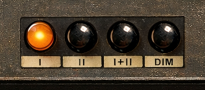
Most BBD chorus pedals have one BBD. The Roland Dimension D, released in 1979, had four. Four MN3209 chips running in parallel with carefully phase-inverted modulation, summed back together. The result was an effect that didn't sound like chorus in the traditional sense. It sounded like the source had been recorded in a slightly bigger, slightly wider room. It also collapsed perfectly to mono, which mattered because most 80s consumer audio was being heard through TV speakers and clock radios.
The Dimension D became famous for not sounding like an effect. Engineers would put it on lead vocals, electric pianos, synth pads, and the result would feel like the source had been moved a foot back from the listener and given some breathing room. You couldn't tell it was on. You could only tell when it was off.
This is why modern BBD plugins worth using have multiple voice modes. A single voice gives you the CE-2 sound. A second voice running at a slightly offset rate gives you the JC-120 ensemble sound. Both voices together, with inverted L/R LFOs, give you the Dimension D mono-safe widening. These are different effects. They use the same core engine, but they're tuned to do different jobs.
Mono Compatibility, and Why It Still Matters
Most music in 2026 gets heard on phone speakers, laptop speakers, Bluetooth speakers, and car stereos. A lot of those listening environments are functionally mono. If your wide stereo chorus has phase issues, what sounded huge in your studio collapses into a thin, weird, partially-cancelled mess on a phone.
The Dimension D was designed around this. Its anti-phase modulation scheme was chosen specifically so the two channels would sum cleanly when collapsed to mono. A lot of cheap stereo chorus designs from the 80s did the opposite: they widened the stereo field by letting the two channels run independently, which sounded great on a hi-fi and terrible everywhere else.
If you're producing music that needs to translate (and most music does), check your modulation in mono. Sum the master to mono, then listen. If your chorus disappears or sounds noticeably worse, the chorus is fighting your stereo image instead of supporting it. Pick a different mode, or pull the width down, until mono and stereo both sound good.
A Practical Cheat Sheet
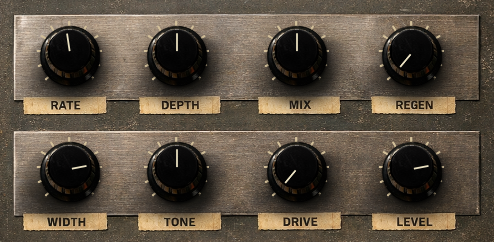
If you're trying to dial in a specific sound, here's where I'd start:
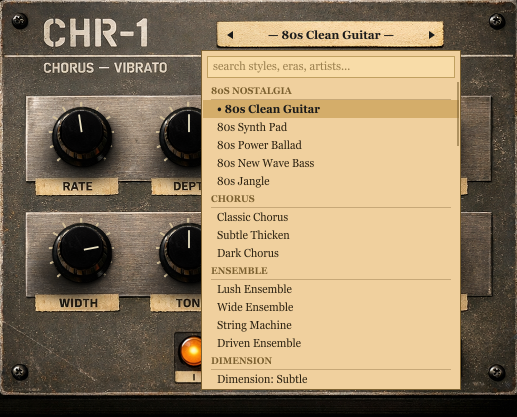
80s clean guitar (Cocteau Twins, The Cure, early U2): Slow chorus, rate around 0.4 Hz, depth around 30 percent, mix at 40 to 50 percent, single voice. The CE-2 territory.
Modern indie chorus shimmer (Mk.gee, Wallows, Boy Pablo): Slow chorus, rate around 0.8 Hz, depth low (15 to 20 percent), mix around 30 percent, dual voice (I+II). Place it after your amp sim, before delay and reverb.
Big 80s synth pad (DX7 era): Dimension voice mode, rate slow, depth very low (5 to 10 percent), mix at 50 percent. The pad shouldn't sound modulated. It should sound bigger.
Slow flanger build (post-rock, Police-style fills): Flanger mode, rate very slow (0.1 to 0.2 Hz), feedback around 60 percent, depth high. Let the sweep take 8 or 16 bars to complete.
Vocal doubler: Doubler mode, asymmetric L/R timing baked in, rate very slow, depth low. Mix at 50 percent. Drop on lead vocals or solo guitar lines.
Subtle vibrato wobble: Vibrato mode, rate around 4 to 6 Hz, depth low. Use sine LFO if available. This is the Beach House, Daniel Lopatin territory.
Always-on phaser color: Phaser mode, rate slow, feedback low, depth moderate, mix around 30 percent. Sit it on rhythm guitars where you don't want an obvious effect, just a moving color.
See It in Action
If you'd rather hear the modes than read about them, here's a walkthrough of CST-1 cycling through the five effect modes with a few of the factory presets. Watch how the Dimension voice mode widens without obvious modulation, and how flanger versus chorus mode reshape the same delay-line architecture.
What Actually Matters
The history of chorus pedals is mostly about one thing: capturing analog texture cheaply. BBD chips were never the best-sounding way to make a chorus. They were the cheapest. They had real flaws, real limitations, real noise. But the limitations turned out to be the sound. The progressive high-end loss, the compander pumping, the bucket coloration, the inherent noise floor. Those weren't bugs. They were the entire reason BBD chorus pedals sound the way they do, and they're the reason a digital chorus that doesn't model these things ends up feeling sterile.
If you're making indie guitar, bedroom pop, dream pop, post-rock, ambient, or any of the genres that draw heavily from 80s production, the right modulation matters. It sits between your amp and your delay, doing quiet work that you only notice when it's wrong. Get it right and the rest of the chain falls into place. Get it wrong and your guitar sounds like a guitar through a plugin, instead of a guitar through an effect.
BBD Chorus FAQ
What is a BBD chorus in one sentence? A chorus effect built on a bucket brigade analog delay chip, whose signal losses and coloration are the "vintage" sound people chase.
Is BBD better than digital chorus? Not better, different. BBD blends into a mix because the wet voice is darker than the dry signal. Digital is cleaner and more flexible. For 80s, indie, dream pop, and lo-fi contexts, BBD character is usually what the record you are referencing used.
Do I need a hardware pedal for this sound? No. The circuit behaviors that matter (darkening with delay time, compander movement, LFO drift) can be modeled. That is exactly what CST-1 does across five effect modes.
Which artists define the BBD chorus sound? Listen to The Cure and Cocteau Twins for guitar, any Juno-era synth pop for keys, and modern players like Mk.gee for how the same circuit family sounds in an indie context today.
CST-1 covers all five
CST-1 is our take on vintage BBD modulation. Five effect modes (chorus, vibrato, flanger, doubler, phaser), four voice modes including Dimension widening, and 41 factory presets across 80s nostalgia, indie, lo-fi, and direct-to-mix categories. Authentic charge transfer darkening, bucket coloration, and analog drift. VST3, AU, Standalone for Mac. VST3 for Windows. $19.
See CST-1If you want to go deeper on any of this, I've got a more general piece on how chorus actually works, and a longer one on lo-fi guitar tones that shares the broader signal-chain context. The 4TRK page covers the tape end of the same chain.